Lenskart is not a weak company. That is precisely why it deserves a serious Projection Gap audit. The lazy critique would say that Lenskart is expensive because it is a retailer being valued like a technology company. That is partly true, but not enough. The more serious question is whether Lenskart is merely an eyewear retailer with better branding, or whether its vertical integration, manufacturing control, omnichannel distribution, data-led store expansion and international footprint justify a valuation framework closer to a platform-enabled consumer infrastructure company.
This distinction matters because Lenskart is one of the few Indian new-age consumer companies that arrived in the public market with profits, scale, supply-chain depth and a visible operating engine. It is not Ola Consumer, where the core business contracted before the repair claim. It is not Zepto, where speed has created demand before the unit economics are fully proven. It is not Urban Company, where a profitable core is funding a high-burn new category. Lenskart is a different animal: a profitable, vertically integrated retail-manufacturing company being asked to justify a valuation that appears far richer than ordinary retail.
Lenskart reported FY25 revenue of about ₹6,652.5 crore and net profit of about ₹297.3 crore, compared with a ₹10.2 crore loss in FY24. Its gross margin improved by over 500 basis points to around 69%, and its DRHP footprint showed 2,723 stores, including 2,067 in India and 656 overseas. At the IPO stage, the company was targeting a valuation of around ₹70,000 crore.
The latest post-listing numbers also look strong. For Q3 FY26, Lenskart’s consolidated revenue from operations stood at ₹2,307.7 crore, up from ₹1,668.8 crore in Q3 FY25, while Reuters reported that profit attributable to owners surged to about ₹131 crore from about ₹1.85 crore a year earlier. The company’s India business, roughly three-fifths of topline, grew strongly, aided by same-store sales growth, while the international arm also expanded meaningfully. So this is not a collapse story. It is a valuation-quality story.
The Financial Autopsy
| Metric | Earlier Period | Latest / IPO Period | Change | Forensic Reading |
|---|---|---|---|---|
| FY24 net result | ₹10.2 Cr loss | ₹297.3 Cr profit in FY25 | Sharp turnaround | Profitability arrived before IPO |
| FY25 revenue | NA | ₹6,652.5 Cr | 23% YoY growth | Scale is real, but growth is not hyper-growth |
| Gross margin | NA | Around 69% | Over 500 bps improvement | Vertical integration is working |
| FY25 stores | NA | 2,723 total | 2,067 India, 656 overseas | Retail footprint is already large |
| Q3 FY26 revenue | ₹1,668.8 Cr | ₹2,307.7 Cr | +38.8% | Post-listing growth remains strong |
| Q3 FY26 profit attributable to owners | ₹1.85 Cr | About ₹131 Cr | Massive jump | Profitability has improved materially |
| IPO valuation | NA | Around ₹70,000 Cr | Very high | Multiple demands exceptional execution |
The first reading is straightforward: Lenskart is performing. The company has built revenue scale, improved margins, turned profitable and continued growing after listing. That places it above many Indian consumer-tech names that entered public discussion with far weaker earnings quality. The second reading is more uncomfortable: good numbers do not automatically justify every valuation. A premium business can still be overpriced, and a strong operating model can still be assigned the wrong valuation category.
The Original Capital-Market Thesis
The Lenskart thesis rests on four arguments. First, India’s eyewear market is underpenetrated and underorganised. Millions require vision correction, but diagnosis, prescription, frame selection and lens fulfilment remain fragmented across local opticians, small retailers and informal channels. Second, Lenskart is not only selling frames. It is organising the entire eyewear value chain: online discovery, offline stores, eye testing, frame design, lens manufacturing, supply chain, private brands, franchise expansion and international retail.
Third, scale improves economics. The more Lenskart controls design, sourcing, manufacturing, stores and consumer data, the more it can improve gross margins, inventory turns and repeat behaviour. Fourth, international markets create an option beyond India. The company’s overseas footprint through Southeast Asia, Japan and the Middle East gives investors a growth story that is larger than Indian organised eyewear alone. This is a stronger thesis than ordinary retail, but it is still not pure technology because the business requires stores, inventory, optometrists, manufacturing, working capital, marketing, leases, customer service and international execution.
The Valuation Gap
At roughly ₹70,000 crore valuation and FY25 profit of about ₹297 crore, the headline valuation implied a very demanding earnings multiple. Some market commentary placed the listing P/E around 230 to 260 times, depending on the metric used, and the Financial Times reported that analysts viewed the business model favourably while warning that valuations were stretched.
This is the central contradiction. Lenskart is profitable, but the valuation assumes that today’s profit is only an early expression of a much larger future operating engine. That may be true, but then the burden of proof shifts sharply. Investors are not paying only for current earnings. They are paying for long-duration execution across India expansion, international growth, margin improvement, manufacturing leverage and brand durability.
At a rich multiple, even a good company must behave almost flawlessly. Same-store sales must stay strong, store payback must remain attractive, international losses cannot re-emerge materially, gross margins must hold, marketing must not inflate, inventory discipline must remain clean, acquisitions must integrate well, and public-market expectations must be managed without damaging growth discipline. A lower-valued company can afford normal execution errors. A company priced for perfection cannot.
The Profit Quality Question
The FY25 profit turnaround is impressive, but investors must separate reported profitability from durable operating profit quality. Entrackr reported that Lenskart posted ₹297 crore profit in FY25 after a ₹10 crore loss in FY24, with ROCE of 6.17% and EBITDA margin of 2.27%, and that the company spent ₹0.99 to earn ₹1 of operating revenue. That creates a more nuanced picture: the business has crossed into profit, but operating profitability was still modest in FY25 relative to valuation.
The Q3 FY26 numbers strengthen the bull case because revenue and profit both improved sharply. But the market must still ask whether this is a sustainable margin trajectory or a period of post-IPO operating leverage helped by recent store maturity, stronger India same-store sales and international normalisation. The valuation cannot be defended merely by saying “profitable”. It must be defended by showing that margins can compound meaningfully without slowing growth.
The International Optionality Test
Lenskart’s international story is both powerful and risky. In Q3 FY26, the international segment reported strong revenue growth, and the segment result improved materially from the prior year. This matters because international expansion is often where Indian consumer companies lose discipline. Overseas markets look attractive in investor presentations, but they bring different rents, labour costs, consumer preferences, brand challenges, inventory cycles, regulations and acquisition-integration risk.
Lenskart’s improvement suggests that the international business is not merely a vanity expansion. It may be turning operationally useful. But the hurdle remains high. If a large part of the valuation depends on international optionality, investors need proof that international profits can scale, not merely turn positive in selected periods. The company must show that acquisitions such as Owndays and overseas store expansion are creating durable economics, not temporary accounting or integration benefits.
The Store Expansion Trap
Lenskart’s store count is a strength, but also a risk. A store network gives the company visibility, trust, eye-testing capacity, service touchpoints and omnichannel conversion. It also creates lease obligations, staff costs, inventory requirements and execution pressure. Once a company becomes a large retail organism, growth quality changes. Early store growth can be accretive because the best markets are opened first. Later store growth may be harder because marginal locations can have weaker payback, higher competition or lower density.
The market must therefore audit store productivity, not merely store count. The key metrics are same-store sales growth, mature-store margins, store payback period, revenue per store, international store maturity, optometrist utilisation, return rates, inventory ageing and franchise versus company-owned economics. Without these, the market is simply applauding footprint.
The Omnichannel Moat
The strongest defence of Lenskart’s valuation is that it is not just a store chain. It is an omnichannel eyewear system. A customer can discover online, test offline, reorder digitally, use stored prescriptions, choose from private labels, upgrade lenses, buy sunglasses, enter repeat cycles through contact lenses, and return to the brand when prescriptions change. This creates more data and repeat behaviour than many ordinary apparel or accessory retailers.
The company also controls manufacturing and distribution more deeply than a typical retailer. Reuters cited analysts who pointed to Lenskart’s control over supply chain and distribution as an advantage in largely unorganised eyewear markets in India and Southeast Asia. But the moat must be measured through economics. If the omnichannel model produces higher gross margins, lower customer acquisition cost, faster repeat purchases, better inventory turns and stronger store productivity, the premium valuation has a foundation. If it produces only brand visibility and store expansion without structurally superior cash generation, then the premium becomes narrative inflation.
The Titan Comparison Problem
The natural public-market comparison is Titan, though imperfect. Titan is not just eyewear; it is jewellery, watches, eyewear and lifestyle retail. But the comparison matters because Titan is one of India’s most trusted examples of premium consumer retail compounding. Reuters reported that Lenskart’s listing valuation was far below Titan’s at the time, but the comparison still matters because public markets understand Titan’s decades-long credibility, brand trust, jewellery economics, cash generation and retail discipline.
Lenskart wants to be judged as a modern consumer compounder. Fair enough. But the market will demand proof that its business can mature into a durable high-return retail platform, not just a fast-growing eyewear chain. Titan-level trust is not built by app downloads or store count alone. It is built by decades of consistent margin, governance, brand equity and capital discipline.
The Listing Signal
The listing itself gave a warning. Reuters reported that Lenskart listed at a discount and was valued at about ₹676.25 billion on debut, even though the IPO was heavily bid. The same report noted that market response was tempered by valuation concerns, despite Lenskart’s FY25 revenue growth and profitability. This is a classic Projection Gap signal: demand for the IPO can be strong and valuation discomfort can still be real.
Oversubscription does not erase valuation risk. It only proves demand for allocation. The post-listing question is whether operating performance can grow into the valuation quickly enough. If Q3 FY26 momentum continues, the company can defend the premium better. If growth slows, margins flatten or international expansion disappoints, the market can reprice the story sharply.
The Unit-Economic Reconstruction
| Unit-Economic Proxy | Latest Signal | Interpretation |
|---|---|---|
| FY25 revenue | ₹6,652.5 Cr | Large consumer-retail scale |
| FY25 net profit | ₹297.3 Cr | Profitability achieved, but valuation remains demanding |
| FY25 gross margin | Around 69% | Vertical integration creates margin strength |
| FY25 EBITDA margin | 2.27% as reported by Entrackr | Operating profit quality was still modest |
| Q3 FY26 revenue | ₹2,307.7 Cr | Strong post-listing growth |
| Q3 FY26 owner PAT | About ₹131 Cr | Profitability improving materially |
| Store footprint | 2,723 in DRHP | Scale creates reach, but also fixed-cost discipline test |
The conclusion is deliberately balanced. Lenskart is not merely a story stock. It has operating substance. But the valuation asks investors to believe that this substance can compound into a much larger profit pool without the usual frictions of retail expansion.
The “Where Does The Cash Come From?” Test
| Cash Source | What Must Be True | Risk |
|---|---|---|
| Same-store sales growth | Existing stores keep growing | Maturing locations may slow |
| Gross margin expansion | Manufacturing and private labels keep improving | Competition may compress pricing |
| International growth | Overseas markets scale profitably | Integration and local-market risk |
| Store expansion | New stores retain attractive payback | Marginal stores may be weaker |
| Premium lens mix | Customers upgrade lenses and coatings | Affordability limits may emerge |
| Tech-led efficiency | Data improves inventory and conversion | Technology advantage may narrow |
The best version of Lenskart is a vertically integrated eyewear compounder with strong same-store sales, high gross margin, disciplined expansion and improving international profitability. The weaker version is a good retailer priced as if it were a superior technology platform. That is the valuation trap.
Status Quo Projection: 3 to 5 Years
| Scenario | Probability | What Happens | Investor Meaning |
|---|---|---|---|
| Best Case | 30% | India same-store sales remain strong, international profits scale, margins improve and store expansion stays disciplined | Lenskart grows into its valuation and becomes India’s first major new-age consumer compounder |
| Base Case | 45% | Revenue grows steadily, profits improve gradually, but valuation multiples compress as the market treats it more like premium retail than technology | Stock returns depend more on earnings growth than narrative rerating |
| Bear Case | 20% | Store expansion slows, international complexity rises, margins flatten and valuation remains too demanding | Market reprices Lenskart as an expensive retailer |
| Systemic Risk Case | 5% | Public markets broadly reject high-multiple consumer-tech listings despite profitable operations | New-age IPO pricing faces harsher scrutiny |
The base case is not failure. The base case is valuation normalisation. Lenskart may keep growing and still disappoint investors if the market decides that an excellent retail-manufacturing company should not trade at technology-style expectations.
The Valuation-Defence Roadmap
Lenskart does not need a turnaround plan. It needs a valuation-defence plan. First, the company should disclose and emphasise mature-store economics more aggressively. Public investors need clarity on revenue per store, payback period, same-store sales growth, mature-store EBITDA and marginal-store economics. A large footprint is useful only if the next layer of stores remains economically productive.
Second, it must separate India and international profitability with more operating detail. The international segment turning profitable is important, but investors need to know whether that profitability is broad-based, acquisition-led, geography-specific or structurally repeatable. Third, the company should defend the valuation through return on capital, not only revenue growth. A premium multiple becomes easier to defend if ROCE rises meaningfully and cash conversion improves.
Fourth, Lenskart must show that technology is not a slogan. It should quantify how technology improves inventory, prescription retention, conversion, supply-chain efficiency, manufacturing throughput, repeat purchase and store productivity. Fifth, it must avoid the classic post-IPO mistake of expanding too aggressively to satisfy growth expectations. A company priced for perfection often damages itself by chasing the growth required to justify that price.
The deeper issue is that Indian markets are entering a new phase of valuation confusion. The old binary was simple: traditional companies were valued on profits, new-age companies were valued on growth. Lenskart breaks that binary. It is profitable, but new-age. It has stores, but also data. It has manufacturing, but also platform-like consumer interfaces. It has international optionality, but also retail execution risk.
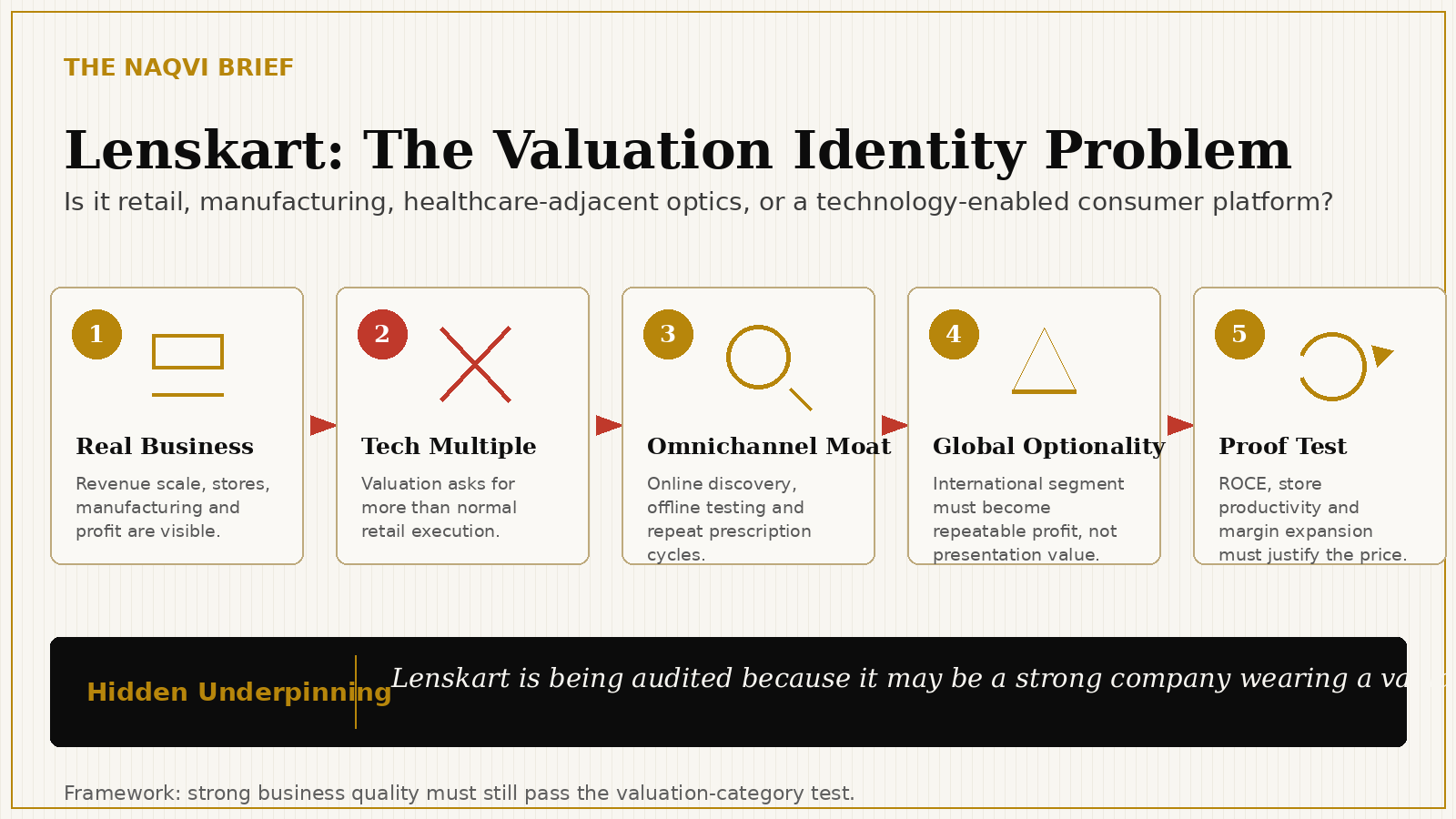
This creates a valuation identity problem. Is Lenskart a retailer, a manufacturer, a brand house, a healthcare-adjacent optical platform, or a technology-enabled consumer compounder? The answer is probably all of these, but markets cannot pay the highest multiple for every identity at once. A company can combine several strengths, but investors must still decide which economic engine deserves the valuation.
Lenskart is not being audited because it is weak. It is being audited because it may be a strong company wearing a valuation that assumes extraordinary execution across too many identities at once.
Final Institutional Verdict
Lenskart is one of the better companies in India’s new-age consumer universe. It has real revenues, real stores, real gross margins, real international presence and real profitability. The post-listing Q3 FY26 numbers strengthen the operating case rather than weaken it.
But The Projection Gap is not only about weak companies. It is about the distance between corporate promise and economic proof. In Lenskart’s case, the gap is not between loss and growth. It is between business quality and valuation category. The company may become a major consumer compounder. It may justify a premium through disciplined store growth, rising margins, international scale and superior omnichannel execution. But investors should not confuse a strong company with an automatically attractive price.
The verdict is precise: Lenskart is not a fantasy business. It is a real business. But public markets must decide whether it deserves to be valued as premium retail, vertically integrated eyewear infrastructure, or a technology-style consumer platform. Until that question is answered through sustained return on capital and margin expansion, the story remains exactly what the headline says: a retail chain wearing a tech multiple.