India does not merely have a political problem. It has an electoral architecture problem.
The viral rise of symbolic anti-system politics in May 2026 is not important because it represents a serious political organisation. It is important because it reveals a deeper generational suspicion: that the existing democratic machine does not convert aspiration into representation with enough honesty.
The visible anger is political. The hidden issue is mathematical.
The real question is not whether India needs a new party. The real question is whether any new party can remain clean inside the old machine.
The First-Past-the-Post Compression
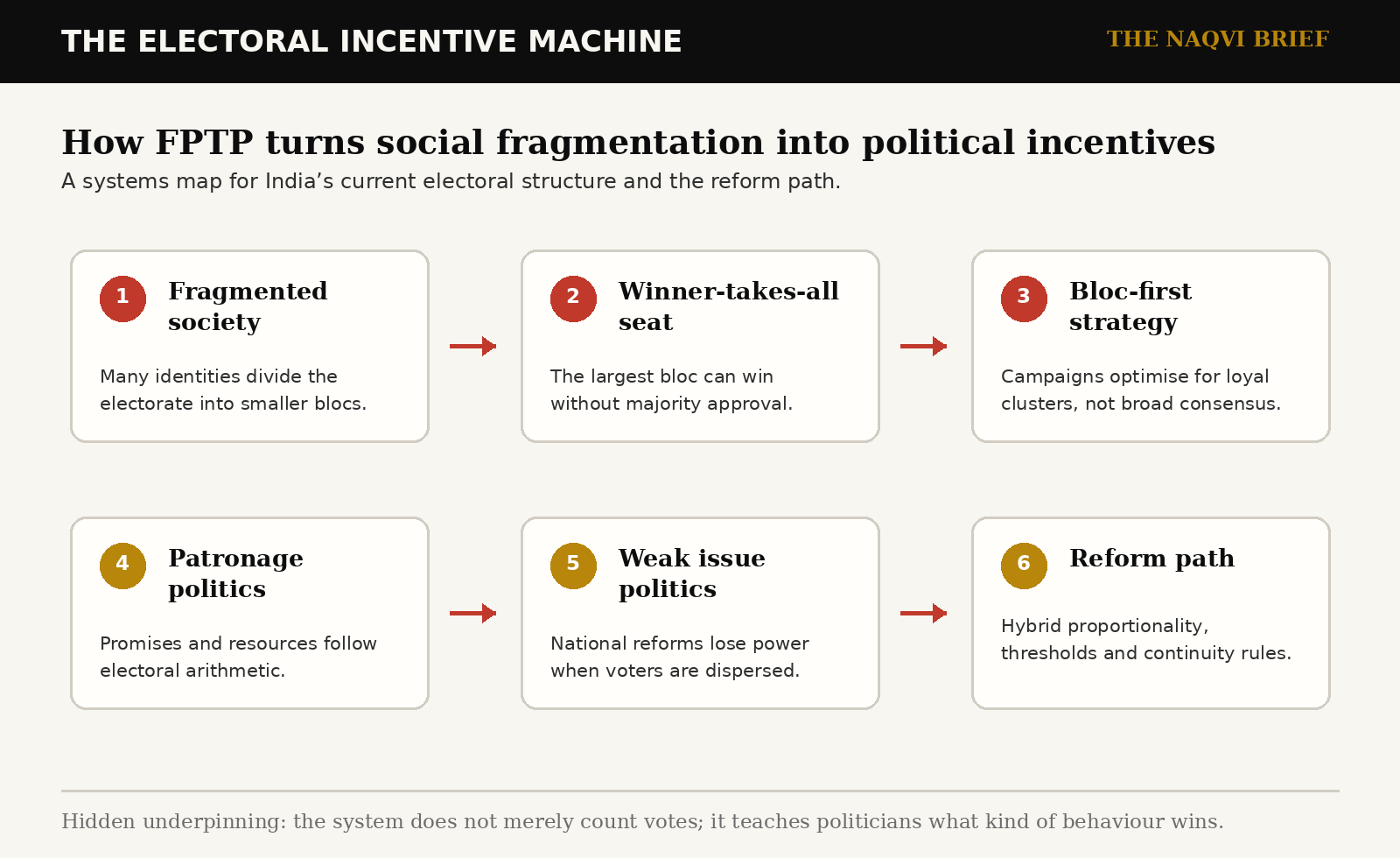
India elects Lok Sabha members through the First-Past-the-Post system. In each constituency, the candidate with the highest number of votes wins. Not the candidate with majority approval. Not necessarily the candidate supported by more than half the voters. Simply the candidate who finishes first.
That distinction looks technical. It is not. It is the central operating code of Indian politics.
In a socially fragmented constituency, a candidate can win by assembling a concentrated bloc while most voters prefer someone else. The system does not ask whether the winner has broad consent. It asks whether the winner has the largest pile of votes.
That is why the system rewards concentration more than consensus.
FPTP does not merely count votes. It teaches politicians which voters are worth pursuing and which voters can be ignored.